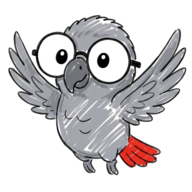
The Skin That Sees
Polly watches Pasta find food under a coloured plate even though octopuses are colour-blind through their eyes. She learns that octopus skin contains the same light-sensing molecules as a human retina.

Before you read
Before you read
The fourth morning, Chiara was running late. She came in carrying two coffees from the bar on the corner and her hair was wet from the sea breeze. She set one coffee on the counter. "I had a thought last night," she said. "We have not done the colour test for Polly."

The colour test was Pasta's favourite, Chiara said. She set out three flat plates of different colours on the tank floor. Bright red. Bright blue. Bright yellow. On one of them, under a small plastic dome, was a piece of shrimp. Today, the shrimp was under the red plate.

"Here is the thing," Chiara said. "Octopuses are colour-blind. Their eyes have only one kind of photoreceptor, not three the way ours do. By every test we have ever done on their eyes alone, octopuses cannot distinguish colours."

Polly tilted her red head.

"And yet," Chiara said. She pointed at the tank. "Watch."

Pasta uncurled. Two arms went out across the tank floor. They passed over the blue plate without slowing. They passed over the yellow plate without slowing. They paused over the red plate. One arm lifted the dome. Pasta took the shrimp.

"She is not blind to colour," Chiara said. "But it is not her eyes that see it."

In the last fifteen years, biologists have discovered that the skin of an octopus is full of light-sensing cells called opsins. The same molecule that lines a human retina lines the entire surface of an octopus arm. The octopus's skin can detect light at different wavelengths. In some species, the skin can detect specific colours.
This is one possible answer to a question that had puzzled biologists for a hundred years: how does a colour-blind animal camouflage itself so perfectly into colourful environments? An octopus on coral matches the coral. An octopus on sand matches the sand. Its eyes cannot see colour. But its skin can. The skin sees what the skin needs to copy.
Pasta withdrew with her shrimp. The whole experiment had taken under a minute.
Polly walked along the rim of the tank slowly. She had never thought about her own eyes before. She had simply trusted them. The idea that an animal could see with parts of itself other than its eyes was, for a moment, deeply strange. She thought, with the small flutter of vertigo it deserved, that she had no idea what most of her own body knew.
Chiara picked up her coffee. "It is interesting, no?"
Polly tilted her red head.
"There is more," Chiara said. "We have published papers on this for a decade. Most people still cannot believe it. The animal's skin sees." She drank the coffee. "Welcome to the part of biology where we don't actually know much."
That's the story.
You just heard Polly
Want to hear what YOU sound like?
Read a line of the story out loud. Your recording stays on your device and is never uploaded.
Not bad, right? In the PollyStop app, Polly listens to exactly that and scores you right away.
Coaching, saved words, spaced repetition, and a fresh story every day.
Get PollyStop freeYour AI tutor
Now say it out loud. Talk about this story with Polly.
Polly is PollyStop's voice tutor. She talks with you about stories like this one, out loud.
Get PollyStop free.
- A new graded story every day, with audio.
- Save the words you meet and practise them later.
- Speaking practice with feedback.
- Polly, the voice tutor, is opening up to more learners.
Keep going at C1
Next stories
Read this story in another language.
Same story, different language. Compare the shape and rhythm without losing the plot.
Keep learning in PollyStop
Listen, save words, practise